
Bill Gates Backed Modern Hydrogen Falls Apart As Funding Dries Up

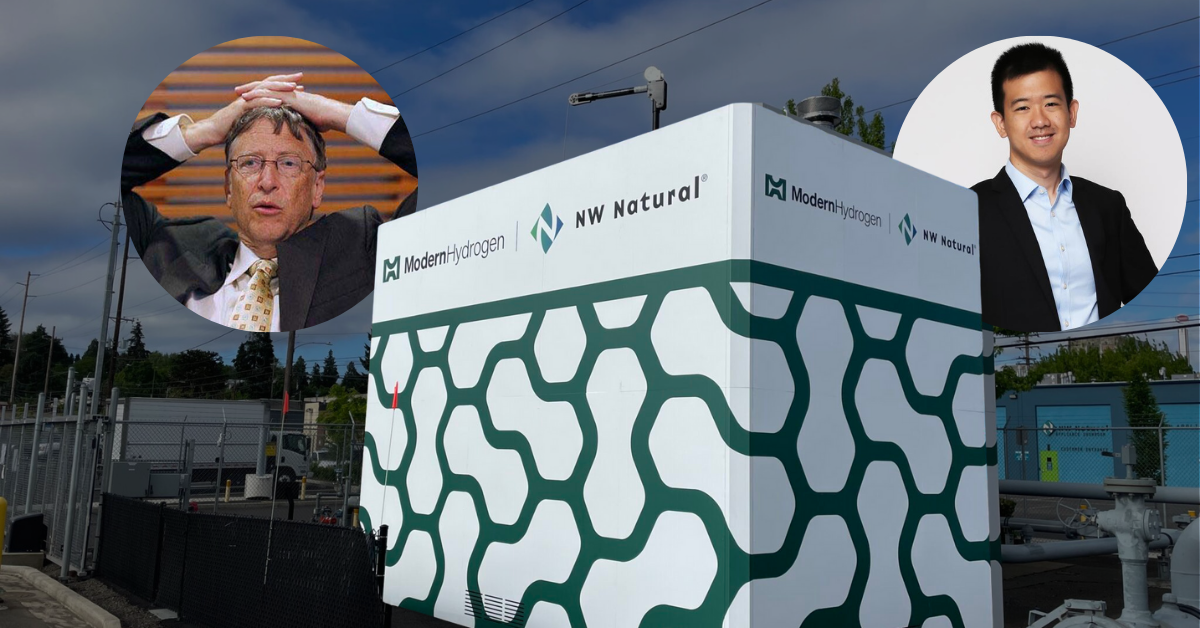
Once a beacon of hydrogen-fuel promise, Modern Hydrogen collapses under funding strain, leaving its future, and the broader hydrogen narrative, in doubt
There was a time when Modern Hydrogen stood among the most hopeful companies at the intersection of climate ambition and industrial innovation. The company’s core technology aimed to convert natural gas into hydrogen while capturing carbon in a solid form, an approach that promised clean fuel without abandoning existing infrastructure.
Over roughly a decade, Modern Hydrogen raised substantial capital, secured high-profile backers including Bill Gates, and rolled out pilot projects that hinted at real-world viability.
Earlier this year, the company appeared on the verge of scaling up, as its first full-size hydrogen-production unit was reportedly being primed for a client in Texas, while a utility in the Seattle area signed a deal to explore the fuel for industrial applications.
Today, that promising trajectory lies in tatters.
The company has laid off most of its employees, and contractors say that their vendors remain unpaid, with internal communications reportedly citing a significant reduction in operations, triggered by a sudden shift in funding.
Those once busy labs, workbenches and pilot-plant corridors are now quiet, which is a startling reversal for a business many believed was on the cusp of delivering clean hydrogen at scale.
A Close-Held Vision Meets Market Reality
Modern Hydrogen’s journey began more than a decade ago under a different name and premise.
Early on, the company sought to repurpose waste heat from residential furnaces and water heaters, but over time, it pivoted, as it rebranded, repackaged, and refocused on hydrogen fuel derived from methane pyrolysis. The premise was compelling, i.e., to produce hydrogen, capture carbon in a solid form with industrial utility, and sidestep many of the pitfalls associated with traditional hydrogen production.
The pivot aligned with a renewed global interest in hydrogen as a bridge fuel for decarbonization, especially in heavy-industry sectors like steel, cement, and chemicals, where electrification remains challenging.
By mid-2025, with hydrogen once again in policy conversations and carbon regulations tightening, Modern Hydrogen seemed poised to ride a wave of renewed optimism. Its planned deployment in Texas and a partnership with a Pacific Northwest utility reinforced that hope.
But behind the scenes, cracks had begun to show, and the startup’s funding runway was narrowing, as its most recent capital infusion reportedly totalled just USD 25 million, which is a modest sum compared with the industrial scale and capital intensity required to bring methane-to-hydrogen technology to market.
Coupled with shifting regulatory support for hydrogen and rising costs for industrial rollout, the financial math became increasingly difficult.
By late October 2025, subcontractors and vendors began to receive terse notifications, as their contracts were terminated immediately, and invoices, and some for tens of thousands of dollars, would go unpaid.
Lives, Trust and Clean-Tech Credibility
For the people who joined Modern Hydrogen’s mission, engineers, scientists, and operations staff, the layoffs mean more than just a job that they have lost. Many had placed hope in a technology they believed could make a difference.
Now, that belief is tainted with uncertainty, disappointment, and the harsh reality that climate-tech is often as unforgiving as the problems it seeks to solve.
Vendors and subcontractors argue that the collapse has left a trail of financial strain, and smaller firms, reliant on timely payments and regular work, now encounter unpaid bills, cash-flow disruptions, and a scramble to recover expenses.
Beyond individual stories, though, the larger impact may echo through the climate-tech sector. Modern Hydrogen’s collapse chips away at confidence in hydrogen as an industrial solution. It presents difficult questions about the scalability, funding requirements, and long-term viability of methane-to-hydrogen technologies, and for investors, policy-makers, and communities looking for silver-bullet climate solutions, the lesson may stoke caution over overhyped promises.
Why This Failure Matters For Hydrogen Hopes and Clean Tech Strategy
Hydrogen has long been framed as a crucial branch in the tree of decarbonization strategies, especially for sectors where electrification remains impractical. Backers like Bill Gates argued that innovations such as those from Modern Hydrogen could reshape energy infrastructure without mass disruption.
But the difficulties faced now highlight a harsh truth of translating laboratory breakthroughs into industrial-scale clean fuel production is a complex, expensive, and risky endeavour. It demands engineering success and also stable long-term financing, regulatory certainty, supply-chain integration, and customer commitments, barriers that continue to derail many clean-tech ventures.
The implosion of a high-profile company like Modern Hydrogen may undermine investor confidence in hydrogen startups and clean-tech broadly. Politically and socially, it may weaken support for hydrogen-based policies, especially when promised solutions fail to deliver.
Liquidation, Rebirth, or Lost Opportunity?
At this moment, the future of Modern Hydrogen remains uncertain, and several paths seem possible, and the first one is, of course, liquidation, which would be assets sold off to repay creditors, intellectual property shelved or acquired by other players.
Another possibility is a restructuring or acquisition, and aspects of Modern Hydrogen’s technology, particularly carbon by-product streams, could still hold value if repurposed under a different business model, perhaps under stricter capital discipline or industrial partnership.
But, for the broader hydrogen sector, this collapse may become a warning sign, as startups, investors, and regulators may demand more rigorous validation, staged rollout plans, and clearer paths to commercialization. Hybrid funding models, blending private capital, public grants, and long-term offtake contracts, could become more common.
A Sobering Reminder About Innovation and Risk
Modern Hydrogen’s failure does not invalidate the science behind methane-to-hydrogen conversion or carbon capture. What it does show, unflinchingly, is that climate-tech is not immune to the same market forces, financial constraints, and risk dynamics that shape any high-stakes industry.
The startup’s collapse is a lesson in humility that reminds us that good intentions, visionary backers, and promising prototypes are no guarantee of success. Real, systemic change demands more, i.e., patience, capital, realism, and sometimes a readiness to fail, cleanly, honestly, and transparently, when the math does not add up.
In the context of the employees, the vendors, the hopeful engineers, and the climate-conscious public who believed in Modern Hydrogen, the collapse leaves more than disappointment, but it does leave uncertainty on the table.
This may be one company’s end, but the questions it leaves behind will shape the future of energy and innovation.