Disney OpenAI Strike $1B Deal To Bring Characters to Sora

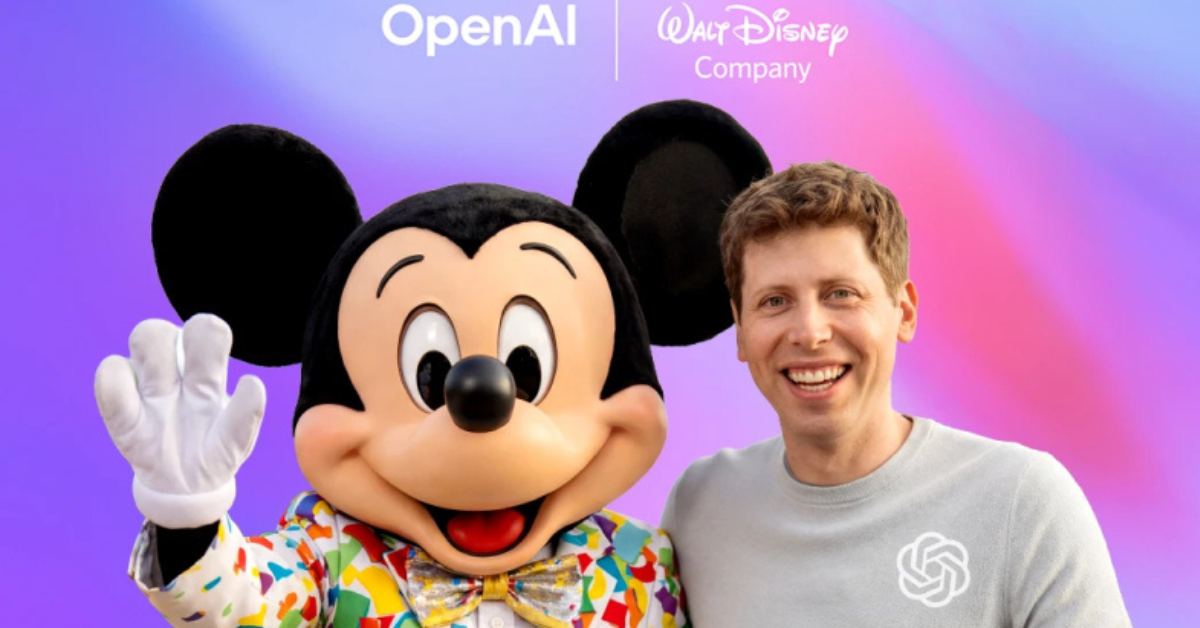
In a landmark three-year deal, the entertainment giant will let fans generate short AI-powered videos with over 200 characters from Disney, Marvel, Pixar, and Star Wars.
The Walt Disney Company and OpenAI have announced a major strategic partnership that stands to change the entertainment industry’s engagement with artificial intelligence, with Disney agreeing to invest $1 billion in OpenAI and to license more than 200 of its iconic fictional characters for use on OpenAI’s short-form generative video tool, Sora, under a three-year agreement signed on December 11, 2025.
This deal marks a departure from the adversarial stance many Hollywood studios previously took toward AI, particularly after a wave of legal challenges earlier in 2025, where Disney and others accused AI companies of training models on copyrighted material without permission. In agreeing to embrace generative AI through a commercial partnership rather than a courtroom battle, Disney is signalling a willingness to explore new creative and commercial frontiers with OpenAI’s technology.
Investment and Licensing
Under the terms of the pact, Disney will become OpenAI’s first major content licensing partner on Sora, and the agreement will allow creators to prompt the AI to produce short videos featuring recognisable characters from Disney’s expansive universe, using text or image prompts on the platform.
Some of these fan-inspired creations will also be eligible for curated display on Disney’s own streaming service, Disney+, further integrating user-generated AI content into the company’s mainstream distribution channels.
Disney will also deploy OpenAI’s technology internally and externally beyond Sora, using tools such as ChatGPT to support product development, enhance internal productivity, and build new interactive experiences for its audiences.
Alongside the licensing revenues and equity investment, Disney will receive warrants to acquire additional OpenAI shares, a structure that aligns both companies’ long-term financial and technological interests.
Importantly, the licensing deal excludes the use of talent likenesses and voices, focusing strictly on the animated characters and their worlds. This limitation reflects broader industry concern about protecting the rights of performers and avoiding unauthorized exploitation of real-world identities in AI-generated media.
AI Strategy and Corporate Rationale
For decades, the Walt Disney Company has treated its intellectual property with extraordinary care, consistently defending its characters’ commercial integrity.
Earlier in 2025, the corporation sent cease-and-desist letters to companies such as Character.AI and even Google over alleged copyright infringements involving unauthorized use of Disney content in AI systems, showing deep industry anxiety about the proliferation of generative models trained on unlicensed material.
Against that backdrop, this licensing and investment agreement can be seen as a pragmatic pivot toward shaping the rules of engagement rather than fighting AI developments solely through litigation.
Disney CEO Bob Iger emphasised that the partnership is designed to extend the reach of our storytelling while responsibly protecting creators and their works, and to put imaginative creative tools directly into the hands of Disney fans in ways we’ve never seen before.
From OpenAI’s perspective, gaining the rights to such valuable intellectual property reinforces the wider legitimacy of its Sora platform and broader generative AI ecosystem.
In recent months, Sora, branded as a social network for AI-generated videos, had already begun to draw widespread use, and at times scrutiny, after users generated unauthorised depictions of well-known characters and public figures, prompting debates about AI, copyright, and ethical limits in creative expression.
Creativity and Corporate
The invitation for Sora users to generate character-based content opens a new chapter where fans participate more actively in narrative play, turning beloved universes into creative raw material for short-form videos that can be shared across social platforms.
Disney has reportedly outlined guardrails, including limits on video duration and a prohibition on replicating voices, designed to balance creative openness with respect for artistic integrity and brand standards.
Critics, however, have raised concerns that such partnerships risk commodifying fan creativity and reducing rich storytelling traditions to algorithm-driven snippets.
Some observers question whether the emphasis on generating vast quantities of derivative content via AI will overshadow more thoughtful, labor-intensive craft in entertainment, a tension that media companies and creative unions have been debating intensely throughout 2025.
Still, the integration of Sora-generated videos into Disney+ and its wider media ecosystem could unlock new forms of audience engagement, from personalised storytelling to interactive fan experiences, representing a significant experiment in how legacy entertainment brands evolve in the age of generative AI.
The scale of Disney’s investment reflects not only confidence in OpenAI’s technological trajectory but also a broader shift in how content owners approach AI innovation, seen no longer strictly as a threat, but as a domain where commercial collaboration and controlled experimentation might yield value for both creators and audiences.
Disney’s move, contrasted with earlier resistance and litigation, may serve as a bellwether for how other major studios approach AI partnerships in the coming years.
As generative AI tools become more integrated with mainstream media consumption and creation, the negotiations over rights, creative control, ethical safeguards, and economic value will continue to shape policy and corporate strategy across the entertainment landscape. Disney and OpenAI’s agreement may be one of the most visible first chapters in this unfolding story, one that blends brand stewardship with technological ambition.
Creativity and Control
Disney’s $1 billion investment in OpenAI and the licensing of its characters to the Sora platform mark a remarkable moment in the evolution of entertainment and fan engagement.
The agreement bridges legacy storytelling with cutting-edge technology under a framework that leverages iconic intellectual property while trying to safeguard creator rights and responsible use. In doing so, it challenges both companies and the wider industry to define new norms for how stories are created, shared, and co-created in an era where imagination and machine learning increasingly intersect.