
Paramount, Netflix & Comcast Enter Bidding War for Warner Bros. Discovery
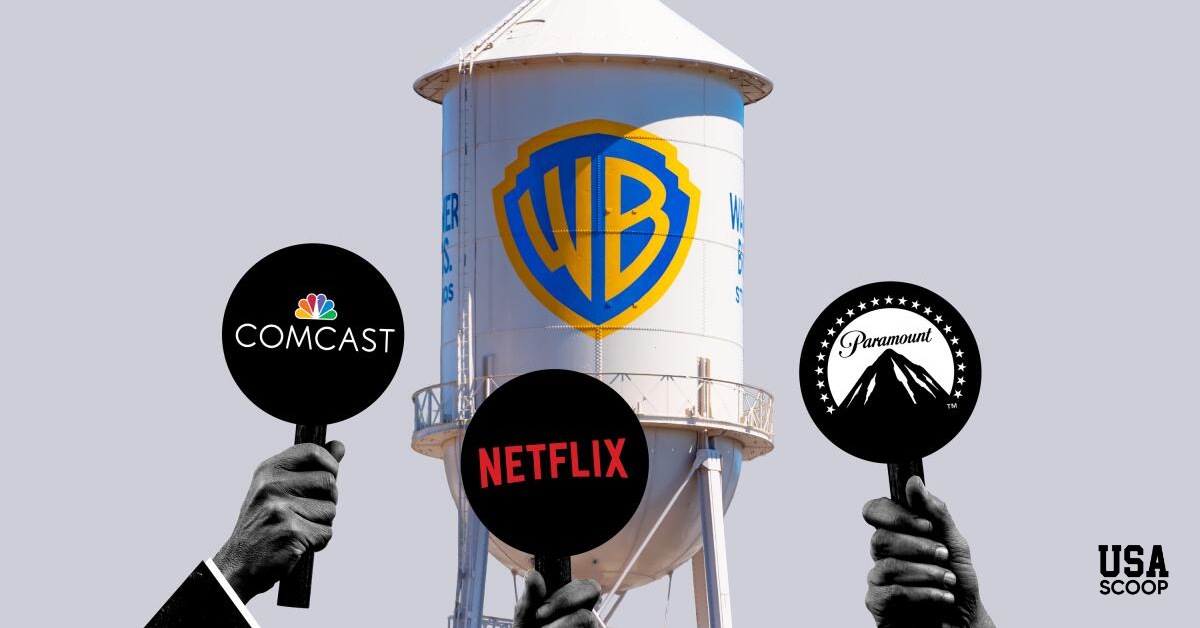
In one of the largest Hollywood shake-ups in years, three major players have entered bids for Warner Bros. Discovery, setting up a potential bidding war and a strategic crossroads for the entire entertainment industry.
With Warner Bros. Discovery’s board setting the deadline of November 20, 2025, for first-round bids, the stakes were clearer than ever, as three powerhouse firms, Paramount Skydance, Netflix, Inc., and Comcast Corporation, all responded with proposals showing they view WBD as a prime acquisition target in a streaming-and-studios economy where scale, library and direct-to-consumer reach hold influence more than ever.
According to an Axios report, each company submitted bids, with Paramount aiming for the full company, while Netflix and Comcast focused on the streaming and studio assets.
Unraveling The Timing of the Bids
WBD’s decision to explore a sale and a break-up isn’t new, as earlier this year it announced plans to split into two companies, one holding its streaming and studios business, and the other possessing its cable networks.
That restructure was intended to unlock value for shareholders by detaching the declining linear business from the expansion-oriented streaming arm.
The bid surge now reflects the sense of urgency within media, as buyers recognise that libraries, direct-to-consumer footprints and global streaming potential may be fleeting in a technology-driven shift, and in that light, WBD is a prize.
Tactics, Strategy, and Who Wants What
Paramount wants to buy WBD in full, including its cable networks such as CNN and TNT.
That would give Paramount Skydance a media empire stretching from linear networks to film studios, global outlets, and major streaming platforms.
Netflix’s strategy is more surgical, since they want the studios, streaming business, and IP such as DC Films and HBO Max, but are reportedly uninterested in the legacy cable channels.
Comcast sits somewhere in between, showing interest primarily in the studio/streaming assets while being less eager to take on federal regulatory risk associated with cable network ownership. This trifurcation of bids IS likely to force WBD into choosing between full sale and break-up.
Value, Risk, and the Price Tag
While exact numbers have remained confidential till now, earlier reports indicated Paramount had floated valuations near $60 billion for WBD, though the company privately rejected bids in the $20- to $24-per-share range.
That gap shows how challenging this market is.
On one side, the upside is enormous, with IP rights, streaming subscriptions, and film studios worth billions.
But on the other side, the legacy cable business continues to shrink, and the regulatory, cultural, and financial risk of such a takeover is also massive. WBD’s board now faces the question of accepting a jumbo bid now or splitting the company and hoping it fetches more value later?
What It Tells Us About Streaming Economics
This bidding process holds a mirror up to the entire streaming and media ecosystem, as streaming growth is slowing, competition is intense, and hence consolidation seems inevitable eventually.
In the case of the buyers, the logic is clear, i.e. of owning the IP library, global distribution, scale, and recurring revenue to compete with tech giants. However, for sellers, the logic is also clear, of cashing in while the bids are high. That WBD has multiple suitors almost simultaneously tells us that media consolidation is critical.
Regulatory and Cultural Hurdles
No one expects this to be a clean deal. Paramount’s bid for WBD, including cable networks, would face intense regulatory scrutiny.
Comcast, although experienced in network ownership, will similarly be scrutinised, and Netflix, for its part, may face fewer regulatory issues if it acquires only the studios/streaming arm.
The cultural dimension is also important here, as brands like CNN are political flashpoints and ownership changes at that level shall attract scrutiny from policymakers and public stakeholders alike.
The board of Warner Bros. Discovery must now evaluate first-round offers and may invite binding bids by year-end.
They may also continue with the planned split in April 2026 as an alternative path. If they choose to sell, it may lead to one of the largest media mergers in years, and if they choose to split, they may instead spin off streaming and studios while letting cable run independently.
Every path carries its own risk, as for the bidders, the race is to show how they will pay, integrate, win regulators, and extract value.
The Implications for Content, Audiences, and Creators
For creators and content buyers, this shake-up resonates because a merged entity may have the power to set global licensing terms and aggregate data like never before.
The audiences may have fewer independent choices in how content is distributed, but it may also mean that content budgets expand because the winner can monetise better globally. For talent, it would mean more leverage if bids integrate studios into broader production platforms, but it also means more centralised power.
What began as a talk about splitting Warner Bros. Discovery has turned into one of the high-stakes bidding wars of the decade.
Paramount, Netflix, and Comcast are all in the ring, and the media world is watching, with the outcome determining who owns which icons of film and television, and it will signal how the entertainment industry realigns for streaming’s next chapter.
At stake is the future architecture of global media itself.