Pentagon Puts Senator Mark Kelly Under Review in Explosive Civil Military Clash

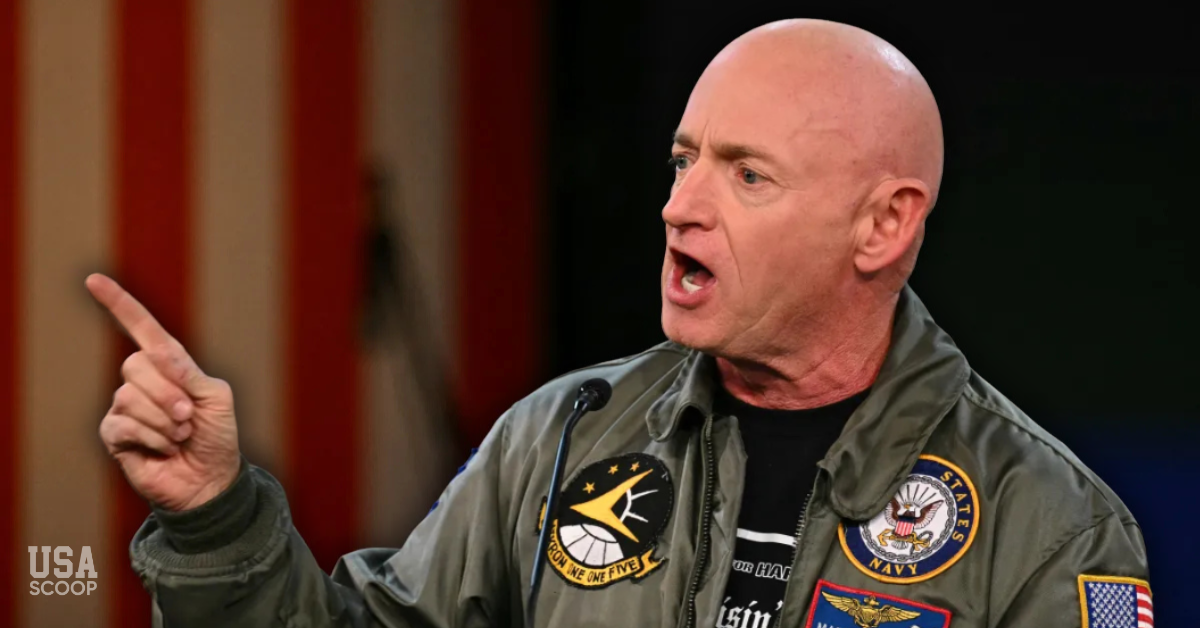
With a decorated veteran-turned-senator requesting troops to question orders, the Defence Department’s response ignited a high-stakes battle over military discipline, congressional speech, and executive power.
On 24 November 2025, the Department of Defense announced that it was launching what it called a thorough review into Senator Mark Kelly for serious allegations of misconduct linked to a video in which Kelly and other Democratic lawmakers appear to advise US service members to refuse illegal orders.
The announcement is striking because it marks one of the few times a sitting member of Congress, and a decorated military veteran, has been explicitly placed under review by the Pentagon under the Uniform Code of Military Justice (UCMJ).
Kelly, a former Navy captain and NASA astronaut, responded by decrying the move as intimidation. “I’ve given too much to this country to be silenced by bullies who care more about their own power than protecting the Constitution,” he said.
The dispute opens a political one, over who’s controlling the conversation when military obligation and partisan politics collide?
What Triggered the Review
The immediate cause is a video released by six Democratic lawmakers with military or intelligence backgrounds, in which Kelly appears and addresses US service members directly: “No one has to carry out orders that violate the law or our Constitution.”
The Pentagon contends that Kelly is the only one among them still subject to the UCMJ because he is a retired officer, and therefore can be recalled to active duty, court-martialled, or administratively disciplined.
Defense Secretary Pete Hegseth described Kelly’s conduct as bringing discredit upon the armed forces and said the case could include recall to active service.
Kelly and his backers saw this as a constitutional duty, as in the video, they argued, highlighted threats to the rule of law, and relied on his status as a military veteran to put across that message. These competing frames set the stage for a confrontation over speech and institutional norms.
Civil Military Relations in Flux
Historically, the US military has maintained a strong tradition of political neutrality, with active service members prohibited from partisan engagement and retired officers wary of entering elected office.
This case blurs those lines, as Kelly was not on active duty when the video was released but still retains obligations under the UCMJ, and the Pentagon’s move showed a readiness to use military law as a tool in a political environment.
Kelly’s legal team leans on his service record, i.e., 25 years in the Navy, combat missions, and NASA astronaut flights. He argued the investigation is retaliation for his congressional oversight of the administration he so publicly critiques.
But the review does raise some thorny questions. Does his duty to speak truth to power as a senator conflict with his residual military obligations?
The review could lead to active duty recall, court-martial, or administrative action for conduct that interferes with the loyalty, morale, or good order and discipline of the armed forces.
The mere initiation of the review places Kelly in an unfamiliar zone, where service, speech, and citizenship converge, and where the rules remain unsettled.
Political Cauldron
The political layer cannot be ignored, as the video came in a climate of heated rhetoric from Donald Trump and his camp, who accused the lawmakers of seditious behaviour and even invoked the death penalty. That Trump’s supporters now seethe at Kelly’s actions adds fuel to the fire.
The Pentagon move is therefore read by many Democrats as a weaponisation of military law for partisan ends by Republicans as a necessary defence of military order. Kelly’s case, hence, has become emblematic of how the military, Congress, and the Executive may clash when national security and politics converge in modern-day US politics.
In practical terms, the review’s trajectory will depend on a number of pivotal developments.
Whether the Pentagon formally recalls Kelly to active duty or merely administers lesser measures, such as a reduction in pension or rank, remains to be seen. Further, will Kelly choose litigation, likely a federal injunction, to block the recall and resolve jurisdictional questions publicly?
Also, there’s the broader impact on legislative-military speech, including the possible tightening of oversight structures.
A Case with Deep Reverberations
At its core, the Pentagon’s review of Senator Mark Kelly is a moment that crystallises the friction between civilian authority and political power.
For a retired Navy captain turned senator to be placed under military review is exceptional, but for it to occur in the broader context of partisan warfare and institutional realignment raises deeper questions about where American democracy is headed.
Kelly insisted that his oath to the Constitution justified his words, and the Pentagon pressed that his video risked undermining the armed forces.
The coming weeks will test whether this is a confined legal action or a watershed in how the military, Congress, and the Executive interact. For Congress, for the military, and for the public, the implications of this review will echo into the very machinery of national governance.