Peter Thiel Dumps Nvidia in a $100M Exit Amid AI Bubble Talk
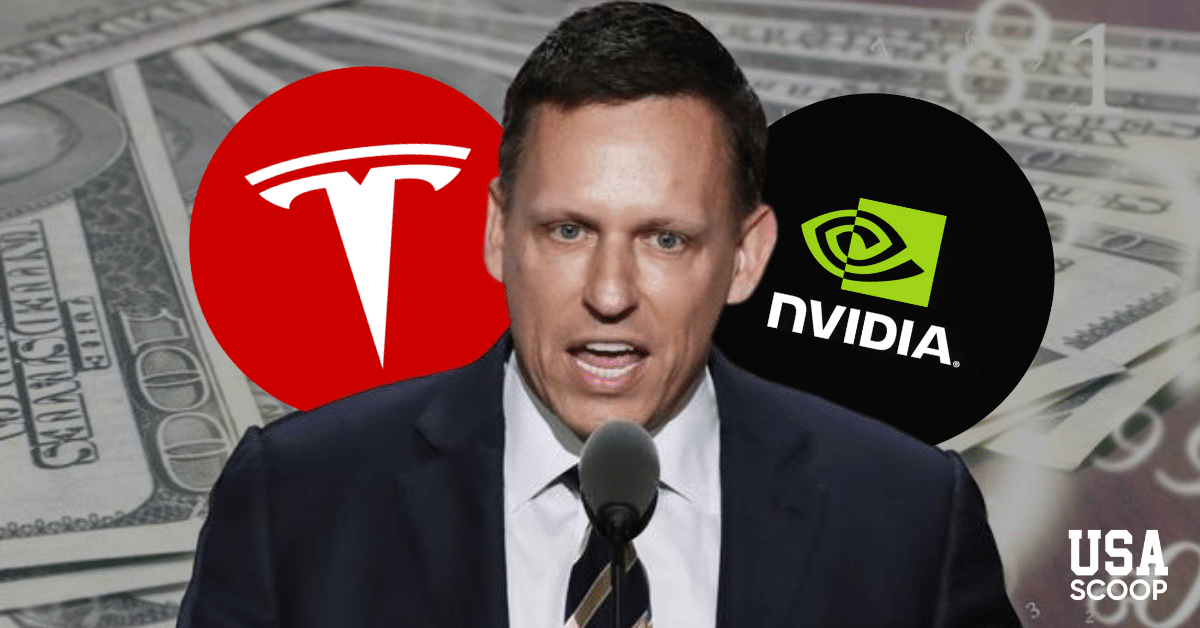
Thiel’s abrupt Nvidia exit and Tesla trim signal rising concerns over an overheated AI market, forcing investors to rethink tech valuation risks.
Peter Thiel has raised eyebrows across Wall Street by making one of his most dramatic portfolio moves in recent memory. According to his Thiel Macro hedge fund’s third-quarter regulatory filings, he completely exited his position in Nvidia, unloading all 537,742 shares, a stake worth nearly $100 million as of September 30. At the same time, he slashed his Tesla holdings, reducing his position from 272,613 shares to just 65,000. This shift reflects a deep-seated concern within his camp about an overheated AI-fueled technology market, a sentiment that echoes across other big players too.
A Calculated Retreat from AI's Flagship
Thiel’s exit from Nvidia is especially striking because of how central the chipmaker has become to the AI boom. Nvidia is widely regarded as a bellwether for demand in data-center compute and AI infrastructure. Yet, Thiel seems to think the current valuations are no longer justifiable.
He has previously warned that Nvidia’s rise resembles a dot-com-style bubble, arguing that investors are pricing in returns that may take years, if not decades, to materialize.
His move comes on the heels of other significant exits: SoftBank, for instance, also sold its entire Nvidia position recently, raising more than $5.8 billion. The timing suggests Thiel is not making a macro-economic call in isolation, but reacting to a broader re-evaluation of risk among top-tier allocators.
From High-Growth to Mega-Cap Stability
The 13F filing shows that Thiel Macro is not stepping away from tech altogether, rather, he's rebalancing toward more diversified, cash-flow rich names. While Nvidia is gone, the fund added 79,181 shares of Apple and 49,000 shares of Microsoft during the same quarter.
These companies offer exposure to cloud, devices, and software, business lines that arguably offer more stable earnings than pure-play AI chip bets.
Meanwhile, Thiel also exited his position in Vistra Energy (208,747 shares), a firm leveraged to energy generation, another sign of major repositioning.
Thiel’s equity book reportedly shrank from $212 million to $74.4 million, a reduction that underscores just how deliberate this pullback has been.
The Tesla Question
Even Thiel’s reduced Tesla holding remains significant, as the 65,000 shares he retains account for a substantial portion of his remaining portfolio. This isn’t a total detachment but a marked de-risking.
Given Elon Musk’s increasingly AI-centric vision for Tesla, from self-driving systems to humanoid robots, the cut could reflect Thiel’s discomfort with how much Tesla’s future is now tied to AI narratives.
Broader Market Implications
Thiel’s exit sends a powerful signal. He is a major voice in Silicon Valley, a co-founder of PayPal and Palantir, and someone who deeply understands both speculative technology and structural innovation.
When he steps back from Nvidia, the implications are twofold. First, skeptics of the AI boom may feel vindicated. If Thiel, who has long supported bold tech plays, thinks it’s time to reduce exposure, others may follow. Second, it could trigger a rotation in capital flows, from high-beta, AI-centric bets toward more diversified and cash-flow-oriented large-cap tech names.
There is also a timing risk, as Nvidia is expected to report third-quarter results soon, and any signs of demand slowdown in its data-center business could amplify worries about sustainability in AI.
Risks and Counterpoints
That said, Thiel’s move is not necessarily the death knell for Nvidia or AI investing. Nvidia continues to enjoy strong demand, and some analysts remain optimistic about its long-term growth trajectory. Thiel’s repositioning could be more about concentration risk or profit-taking than a definitive verdict on AI’s future.
Moreover, exiting a large stake does not mean he’s abandoning tech entirely. By shifting into Microsoft and Apple, Thiel is still very much invested in innovation, just in companies with more diversified revenue streams and what he might view as more sustainable business models.
A Strategic Warning Shot
Peter Thiel’s Q3 filing should be read as a wake-up call. His complete exit from Nvidia and deep cut in Tesla reflect not just profit-taking, but a serious reassessment of risk in the AI space. It’s a reminder that the sky-high valuations driving the AI narrative aren’t immune to scrutiny.
For investors, it raises strategic questions. Are we overestimating AI’s short-term returns? Should capital be reallocated to more durable technology franchises? And, crucially, is this a signal that the current tech boom may be approaching a tipping point?
Whatever the answers, Thiel’s move is now part of the conversation, and it’s one that the rest of the market is watching very closely.