Press Freedom at Risk? New York Times Takes Pentagon to Court

The fight over who gets to cover America’s military hits the courts as independent journalism confronts government-enforced control.
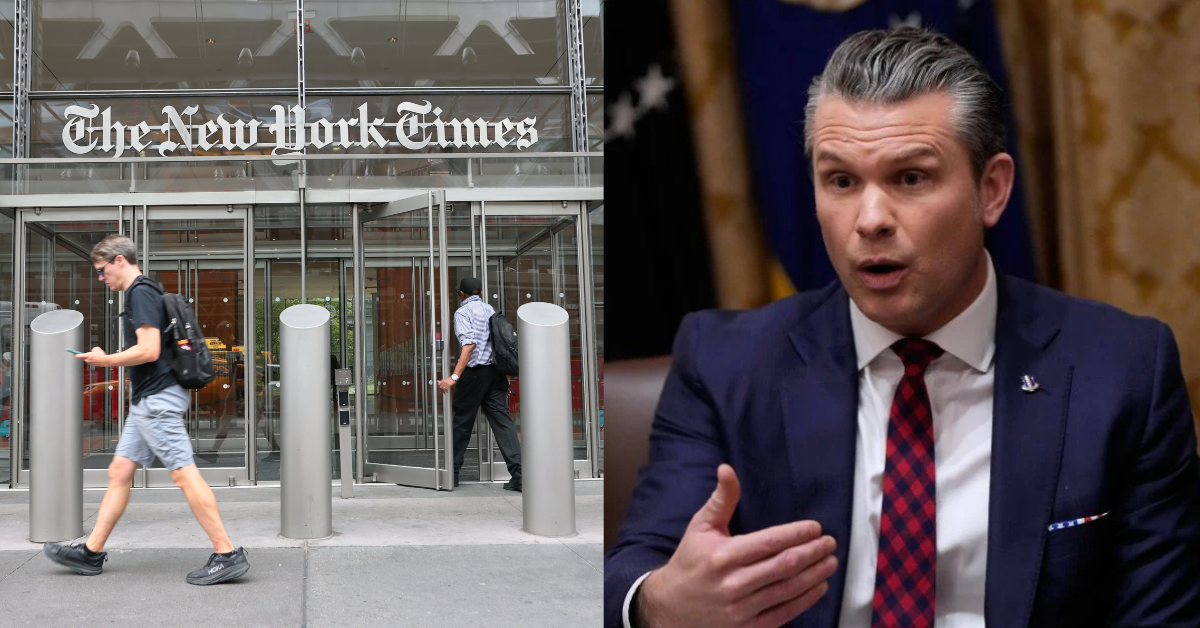
It began in mid-October 2025 when Defense Secretary Pete Hegseth unveiled a new media policy for the Pentagon requiring all credentialed journalists to sign a 21-page agreement that forbade them from soliciting or reporting any information, even unclassified, unless explicitly authorized by Pentagon officials. Many leading newsrooms balked.
Within days, dozens of major outlets, including The New York Times, CNN, The Washington Post, Reuters, The Associated Press, and others, relinquished their press passes rather than submit to what they described as gag-order conditions.
On December 4, 2025, The New York Times responded with a federal lawsuit filed in Washington, D.C., naming the DoD, Hegseth, and spokesman Sean Parnell as defendants.
The paper argued that the policy violates both the First Amendment’s free-press guarantee and the Fifth Amendment’s due-process protections, since the Pentagon now holds unilateral power to revoke credentials without meaningful standards or appeal.
Why Journalists Say They Are Unconstitutional
Under the new policy, any journalist credentialed by the Pentagon must pledge not to solicit government employees to disclose non-public or unauthorized information, even if unclassified. Reporters must also restrict their movement inside the building, remain under escort, and rely almost entirely on material cleared by defense officials.
The rules amount to a suppression of independent journalism for critics, which turns reporters into stenographers and strips the public of its right to know. As The New York Times’ filing bluntly puts it, the policy seeks to restrict journalists’ ability to do what journalists have always done, and ask questions of government employees and gather information to report stories that take the public beyond official pronouncements.”
The effect has been dramatic, as legacy media that once maintained a permanent presence inside the Pentagon have been replaced by a press corps composed largely of pro-administration outlets and influential supporters loyal to the current leadership. The paper contends this reordering was by design.
A Legal Battle With High Stakes for Democracy and Transparency
The lawsuit challenges the policy on constitutional grounds and points to decades of legal precedent protecting the press’s right to gather news, including unflattering or controversial material, without government interference. The New York Times invoked the principle long upheld since the landmark 1971 case, which affirmed its own right to publish the Pentagon Papers.
The timing of the lawsuit coincides with the Pentagon's facing public scrutiny over controversial military operations and decisions. Without independent reporters inside, critics argue the DoD may control both the narrative and the facts, effectively eroding mechanisms of accountability and oversight.
Support for the Times’ move has come from press-freedom groups and former Pentagon correspondents who warn of a chilling effect; as if the policy is allowed to stand, it may serve as a model for other federal agencies. The precedent could shift the burden of disclosure entirely onto officials, leaving the public dependent on what the government allows.
What the DoD Says And Why Its Arguments May Falter
From the Pentagon’s perspective, the new policy is framed as a common-sense measure in an age of leaks and rapid digital dissemination. Officials argue that even unclassified data, if released without context or vetting, can pose operational risks. By requiring prior approval and limiting unsupervised access, the DoD insists that it protects national security, troop safety, and the integrity of classified processes.
Yet the lawsuit contends these arguments mask a deeper motive, i.e., controlling unfavourable coverage and excluding skepticism. The broad and vague nature of the restrictions, combined with their sweeping application to unclassified material, makes it difficult for journalists to know what is allowed and what might cost them their access. That ambiguity, a court filing argues, violates both constitutional safeguards and long-standing norms of open government.
What This Means for Journalism and Oversight
If the court sides with The New York Times, the ruling could restore independent media access to the Pentagon, reiterating that the Fourth Estate is not subordinate to security-driven gatekeeping. It could affirm that even information the government deems non-sensitive belongs to the public once it’s real news.
However, if the policy survives legal challenges, it could mark the beginning of a new era, one in which governments dictate not only what’s secret but what the media may even ask about. The consequences for transparency, oversight, and trust in institutions would be profound in that context.
In the case of democracy advocates, military watchers, and everyday citizens, the outcome will matter about troop deployments or weapon systems, and for what the public knows about how its military is run.
What to Watch Next
The lawsuit has been assigned to Senior Judge Paul L. Friedman in the U.S. District Court for the District of Columbia. The Times has sought an injunction to prevent enforcement of the rule while the case proceeds. Legal analysts say the court’s decision will weigh heavily on whether blanket prior-approval requirements for news reporting survive constitutional scrutiny.
Press-freedom groups will likely file amicus briefs in support of the lawsuit. Meanwhile, other disenfranchised media organisations, including The Associated Press, Reuters, and others, are expected to watch the outcome closely, as the decision could influence their own ability to cover federal agencies going forward.
As the case unfolds, one thing remains certain, i.e., the courtroom may become the next battlefield in a broader fight over press freedom, state power, public oversight, and the very meaning of transparency under the modern US government.