Trump Threatens 100% Tariffs on Canada Over China Deal, Sparking Trade Shockwaves
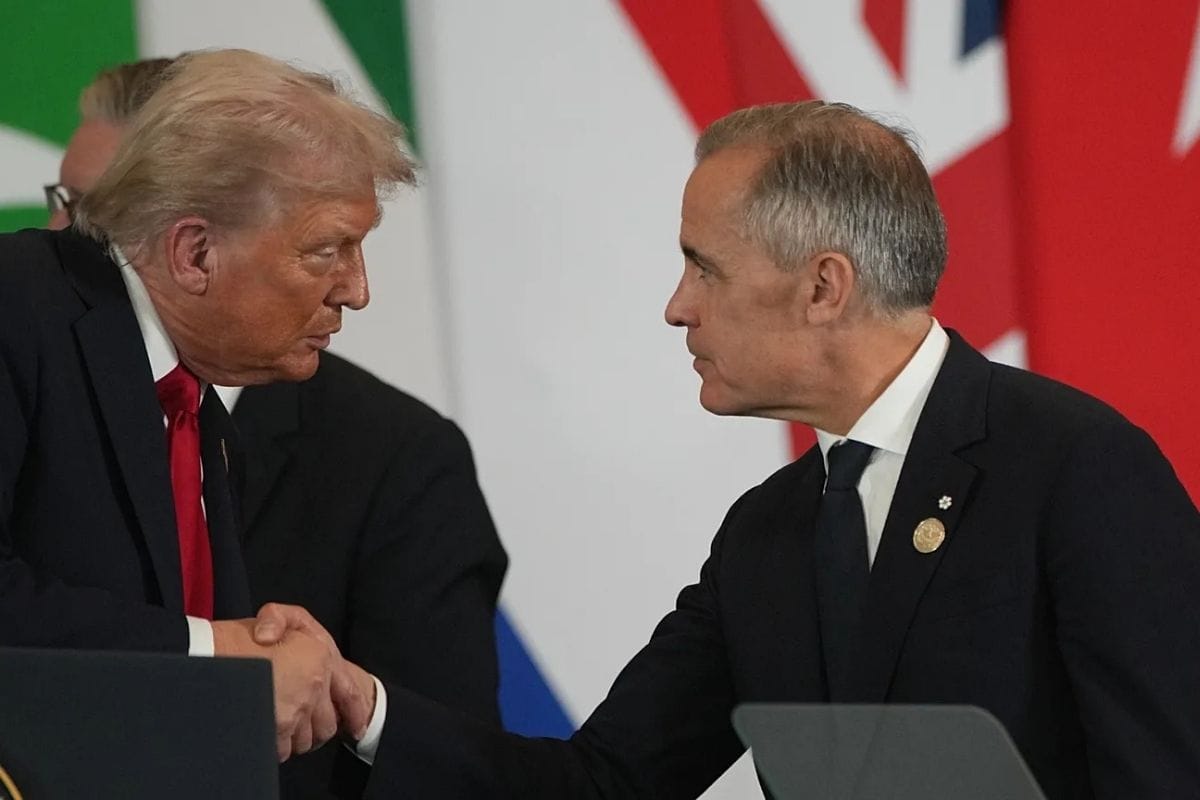
A fresh wave of trade tension has erupted between the United States and Canada after President Donald Trump warned that he would impose sweeping tariffs on Canadian goods if Ottawa deepens its economic ties with China. The warning, delivered through Trump’s social media platform, marks another sharp escalation in a relationship that has grown increasingly strained in recent weeks.
Trump’s message was blunt and unmistakable. If Canada makes a deal with China, he said, it would face a 100% tariff on all goods entering the United States. The remark immediately raised alarms among businesses, policymakers, and trade experts on both sides of the border, given how deeply intertwined the U.S. and Canadian economies are.
While Trump did not specify which agreement he was referring to, his comments appear to target Canada’s recent efforts to reset its relationship with Beijing. Just days earlier, Canadian Prime Minister Mark Carney announced what he described as a “strategic partnership” with China, including steps to ease certain tariffs that had been in place for years. At the time, Trump even called the move “a good thing,” making his sudden reversal all the more striking.
A Relationship Under Strain
Tensions between Washington and Ottawa have been simmering for months, but they intensified after Carney spoke at the World Economic Forum in Davos. In that speech, the Canadian prime minister argued that the U.S.-led global order had been “ruptured” and warned that middle-sized countries like Canada could no longer rely on old assumptions about stability and free trade.
Carney urged what he called “middle powers” to work more closely together to protect themselves from economic pressure exerted by larger nations. Though he did not mention Trump by name, the message was widely interpreted as a critique of the U.S. president’s aggressive use of tariffs as a political and economic weapon.
Trump responded the following day sharply, dismissing Canada’s independence in stark terms. “Canada lives because of the United States,” he said, a remark that sparked outrage among Canadian officials and citizens alike. Soon after, Trump withdrew an invitation for Canada to join his newly announced “Board of Peace,” another symbolic move that signaled a cooling of relations.
The China Factor
At the heart of the dispute is Canada’s effort to diversify its trade relationships, particularly with China. For decades, Canada has relied heavily on the U.S. as its primary trading partner. While that relationship remains vital, Trump’s unpredictable tariff policies have pushed Canadian leaders to look elsewhere for stability.
The recent agreement between Canada and China included several notable changes. China agreed to sharply reduce tariffs on Canadian canola oil, cutting them from an eye-watering 85% down to 15% by March. In return, Canada lowered its tariffs on Chinese electric vehicles from 100% to a more standard 6.1%, known as the most-favoured-nation rate.
The deal was seen by many in Canada as a breakthrough after years of strained relations marked by tit-for-tat tariffs and diplomatic freezes. It also opened the door to potential new Chinese investment in Canadian industries, something Ottawa views as key to strengthening its economy in an increasingly uncertain global landscape.
Trump, however, sees the situation very differently. In his social media post, he accused Canada of potentially acting as a “drop-off port” for Chinese goods, suggesting that Beijing could use Canada as a backdoor into the U.S. market. “If Carney thinks he is going to make Canada a drop-off port for China to send goods into the United States, he is sorely mistaken,” Trump wrote.
Canada Pushes Back
Canadian officials were quick to respond, pushing back against the idea that the country is pursuing a full-fledged free trade deal with China. Dominic LeBlanc, Canada’s minister responsible for U.S. trade, said there is no plan for such an agreement.
“There is no pursuit of a free trade deal with China,” LeBlanc said, emphasising that the recent talks were focused on resolving specific tariff disputes rather than opening the floodgates to unrestricted trade.
LeBlanc added that Canada’s priority is building a stronger domestic economy while expanding trade partnerships around the world. “We are focused on strengthening trade relationships globally,” he said, “not undermining our relationship with the United States.”
That reassurance may do little to calm fears, however. The U.S. remains Canada’s largest trading partner by far, and a 100% tariff would be devastating for industries ranging from automotive manufacturing to agriculture and energy.
Economic and Political Fallout
The prospect of such massive tariffs has already sparked concern among business leaders. Many Canadian companies rely on the U.S. market for survival, while American consumers benefit from affordable Canadian imports. A sudden tariff shock could drive up prices, disrupt supply chains, and cost jobs on both sides of the border.
Politically, the threat also puts pressure on Carney at home. While many Canadians support reducing dependence on the U.S., they are also keenly aware of how vulnerable the economy could be if relations with Washington deteriorate further.
Carney has defended his approach, arguing that Canada must adapt to what he calls a “new world order.” In his view, spreading economic risk across multiple partners is not an act of defiance but a necessary step to protect Canadian sovereignty and stability.
What Comes Next
It remains unclear whether Trump will follow through on his threat or whether the tariff warning is meant primarily as leverage. His history of using tariffs as both a negotiating tool and a political message leaves room for uncertainty.
What is clear is that the once-stable U.S.-Canada relationship is entering a more volatile phase. With global power dynamics shifting and economic alliances being redefined, both countries are navigating unfamiliar territory.
For now, businesses, investors, and citizens on both sides of the border are left watching closely, hoping that cooler heads prevail before trade threats turn into economic reality.