US Interior Secretary Meets Venezuela Officials Over Mining Talks
US Interior Secretary meets Venezuelan officials and mining companies in rare talks focused on natural resources and potential economic cooperation.
For years, the relationship between Washington and Caracas has felt frozen.
Sanctions, political disputes and sharp rhetoric pushed the United States and Venezuela into a long period of minimal contact. High-level visits became rare. Conversations that once happened openly shifted to the background or disappeared entirely.
That is why a recent visit by the US Interior Secretary to Venezuela caught so much attention.
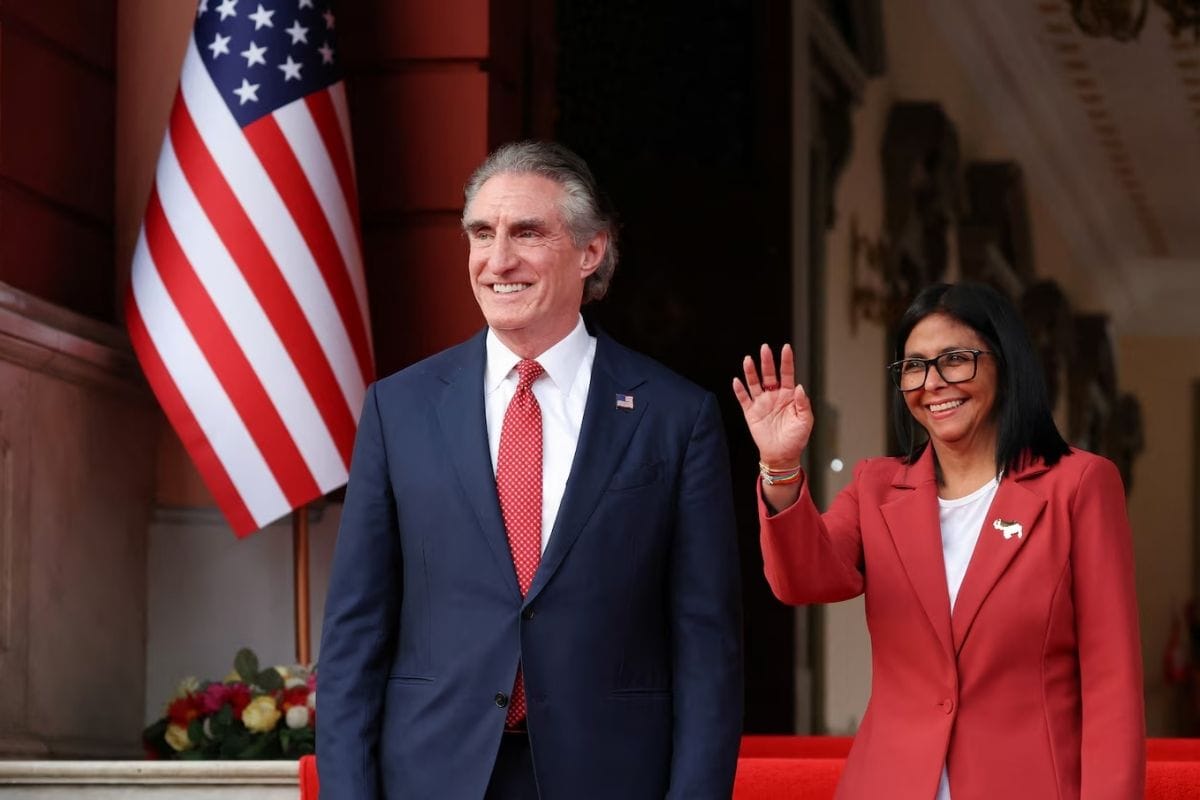
During the trip, the American official met with Venezuelan Vice President Delcy Rodríguez and also held discussions with representatives from mining companies operating in the country. The focus of the meetings was not political speeches or diplomatic symbolism. Instead, the conversations centered on something practical: natural resources.
Venezuela has enormous reserves of oil, gold and other minerals. Yet much of that potential remains underdeveloped after years of economic turmoil and international sanctions.
The visit did not produce dramatic announcements. No agreements were signed, and neither side suggested that the long-running political conflict between the two governments had suddenly disappeared.
Still, the meeting itself carried significance. It showed that both countries are willing, at least cautiously, to sit down and talk again.
A Rare US Visit to Caracas
High-level American officials rarely travel to Venezuela these days.
Relations between the two governments deteriorated sharply over the past decade. Washington imposed sanctions on Venezuela’s leadership and several key industries, including the oil sector. The measures were meant to pressure President Nicolás Maduro’s government over concerns about democracy and human rights.
Venezuela’s leadership rejected those accusations and blamed the sanctions for worsening the country’s economic crisis.
As tensions deepened, diplomatic engagement nearly stopped. Formal meetings between senior officials became unusual events.
That is what makes the Interior Secretary’s visit stand out.
According to officials familiar with the discussions, the trip focused on economic and resource issues rather than broader political disputes. The conversations reportedly involved mining operations, investment possibilities and the management of natural resources.
Business representatives also joined parts of the meetings, highlighting the interest companies still have in Venezuela’s resource sector despite the complicated political environment.
The visit did not erase the tensions between the two governments. But it showed that communication has not completely disappeared.
Venezuela’s Resource Wealth Still Draws Attention
Even during years of economic decline, Venezuela’s natural resources have remained impossible to ignore.
The country holds some of the largest proven oil reserves in the world. For decades, petroleum exports formed the backbone of its economy.
Beyond oil, Venezuela also possesses extensive mineral deposits, including gold and other valuable metals found in its southern regions.
In theory, those resources could support significant economic growth. In reality, the sector has struggled.
Infrastructure problems, declining investment and political uncertainty have slowed development across both the oil and mining industries. Many international companies pulled back operations as sanctions tightened and economic conditions worsened.
Even so, the potential remains.
That potential explains why discussions about mining and energy continue to surface whenever diplomatic conversations reopen.
Mining Emerges as a Key Topic
Mining was one of the main issues discussed during the recent meetings.
Large areas of southern Venezuela contain gold deposits and other valuable minerals. Over the past decade, informal mining activity has expanded in some of these regions, often operating outside official regulations.
That expansion has created environmental concerns and security challenges.
Government officials in Caracas have suggested that partnerships with international companies could help bring more structure and oversight to the sector. Modern technology, investment and regulatory frameworks could transform mining into a more stable industry.
Executives from mining companies reportedly took part in discussions during the visit, suggesting that private-sector interest in the country remains strong.
For the United States, interest in mining is not only about Venezuela.
Across the world, governments are paying closer attention to mineral supply chains. Metals and rare materials play a critical role in modern technologies, including renewable energy systems, electric vehicles and advanced electronics.
Ensuring access to these resources has become a strategic priority for many countries.
If Venezuela’s mining industry eventually develops under clearer rules and stronger investment conditions, it could become part of those global supply chains.
Sanctions Still Shape the Relationship
Despite the more constructive tone of the meetings, the larger political issues between Washington and Caracas remain unresolved.
US sanctions on Venezuela are still in place. Washington has repeatedly said that significant changes in those policies would depend on political reforms and credible democratic processes inside the country.
Venezuela’s government continues to criticize the sanctions, arguing that they have deepened economic hardship for ordinary citizens.
Those disagreements make any economic cooperation complicated.
Companies considering investments must navigate legal restrictions and political uncertainty. Governments must balance strategic interests with diplomatic positions.
For that reason, the visit should not be interpreted as a sudden breakthrough.
Instead, it appears to be a cautious step toward reopening communication in areas where practical interests overlap.
A Small Step Toward Dialogue
Diplomatic relationships rarely change overnight.
More often, they evolve slowly through small gestures and exploratory conversations. Meetings that focus on technical issues or economic cooperation sometimes serve as early steps toward broader dialogue.
The Interior Secretary’s visit to Venezuela may represent exactly that kind of moment.
For Venezuela, rebuilding its economy will likely require new investment and stronger international partnerships. Resource sectors such as mining and energy remain central to that goal.
For the United States, maintaining influence and engagement in the region’s economic landscape carries its own strategic value.
Neither country appears ready to abandon its political positions. But both seem willing to talk at least in limited ways.
For now, the meetings in Caracas do not change the larger political story between Washington and Caracas.
What they do show is something simpler but still important: after years of tension, the door to conversation has opened slightly again.
And sometimes, in diplomacy, even a small opening can matter.